
 vs
vs
SendKit vs PlusVibe (2026): Enrichment-First vs Infrastructure-First Outbound
A workflow comparison of two AI cold email platforms with opposite product philosophies. PlusVibe puts an 80-source enrichment engine at the center. SendKit puts isolated sending at the center. The day-to-day UX, integration depth, and migration story differ accordingly.

The Verdict
These two products solve adjacent problems with opposite priorities. PlusVibe (the rebranded pipl.ai) builds outward from an enrichment engine: an SDR opens the app, picks a list, and the platform writes the opener using 80+ data sources before the sequence ever ships. SendKit builds outward from sending infrastructure: an SDR opens the app, picks a list, and the platform routes the send across isolated IPs and a controlled warmup pool before content quality even enters the picture.
The PlusVibe workflow optimizes for "what should this email say." The SendKit workflow optimizes for "will this email land." Teams that win on personalization quality (founder-led sales, mid-market consulting, agencies selling story) feel the difference on PlusVibe within the first sequence. Teams that win on volume reliability (high-velocity SDR teams, agencies running 30+ mailboxes, B2B SaaS at scale) feel the difference on SendKit within the first month. Pricing splits along the same line; full pricing breakdown for PlusVibe is on the pricing page.
SendKit vs PlusVibe: Feature-by-Feature
| Feature | |  PlusVibe PlusVibe |
|---|---|---|
| Infrastructure | ||
| Dedicated IPs | Every plan Dedicated IP assigned on all plans from $99/mo | No Shared infrastructure on all plans |
| Isolated Infrastructure | Yes Fully isolated sending, no shared pools | No Shared sending pool, no isolation |
| Email Warmup | Unlimited, AI-powered AI warmup designed to pass detection filters | Private pool Private warmup pool included on all plans |
| Email Validation | Built-in, every plan Pre-send validation included | Built-in Validation included in platform |
| Inbox Placement Testing | Built-in Test inbox vs spam placement before each campaign | No No native inbox placement testing |
| Blacklist Monitoring | Built-in Real-time blacklist alerts | No No blacklist monitoring |
| Sending | ||
| Email Accounts | Unlimited Effectively unlimited under a generous fair-use policy that typical users never reach | Unlimited Unlimited email accounts on paid plans |
| Monthly Emails | 75K to 2.5M 75K (Essential) to 2.5M (Agency) | 250 to 1M 250 (Free) to 1M (Pro at $225/mo) |
| Lead Storage | 30K to Unlimited 30K on Essential, unlimited on Pro and Agency | 50 to 200K 50 (Free) to 200K (Pro at $225/mo) |
| Features | ||
| AI Personalization | Yes AI-powered sequence optimization | Advanced AI personalization with enrichment from 80+ data sources |
| Built-in Dialer | Yes Native cold calling on every plan | No No built-in dialer |
| Lead Database | 350M+ contacts Built-in lead finder | Enrichment only Enrichment from 80+ sources, not a standalone lead database |
| Webhooks | Yes 6 event types with HMAC verification | Basic Standard integrations available |
| Scale | ||
| White-label | From $499/mo Full white-label on Pro plan | No No white-label offering |
Switch to SendKit
Dedicated IPs. Isolated infrastructure. From $99/mo.
Pricing Comparison
75,000 emails · 30,000 leads
Full stack included
250,000 emails · 100,000 leads
Finder credits scale up
500,000 emails · Unlimited leads
White-label tier
2,500,000 emails · Unlimited leads
Account manager included
PlusVibe250 emails · 50 leads
Evaluation only
10,000 emails · 2,000 leads
Single SDR scope
250,000 emails · 50,000 leads
Most teams stop here
1,000,000 emails · 200,000 leads
Highest published tier
Pricing takeaway
Both tools publish every tier on a public page, so price comparison is straightforward at the SKU level. Where the math gets meaningful is per-feature: PlusVibe ladders are throughput-only with the full feature set at $30; SendKit ladders are throughput-plus-capacity with finder credits and lead caps moving in lockstep with sends. See /plusvibe-pricing for the per-email cost analysis at each PlusVibe tier and the billing watchpoints worth confirming before you commit.
Enrichment-first vs infrastructure-first
PlusVibe and SendKit answer different first questions. PlusVibe answers "what should we say to this prospect" by pulling 80+ enrichment signals into an AI personalization layer that writes the opener for you. SendKit answers "will this prospect actually see the email" by routing each send through an isolated mailbox-to-IP pipeline with placement controls.
The difference shows up in onboarding: PlusVibe asks you to upload a list and grade the generated copy on day one. SendKit asks you to verify mailbox setup, warmup status, and routing before generating anything. Neither approach is universally correct.
Founder-led sales and senior SDRs running 50 to 200 highly-targeted accounts get more lift from PlusVibe's enrichment layer than from any infrastructure improvement. High-velocity teams running 50K+ sends per month feel the inverse: the personalization layer can only do so much when 30 percent of sends are landing in promotions.
Key takeaways
- PlusVibe first question: what should this email say
- SendKit first question: will this email be delivered
- PlusVibe shines on low-volume, high-research outbound
- SendKit shines on high-volume, reliability-critical outbound
What the first 60 minutes look like in each tool
Setting up PlusVibe Starter: connect one or two mailboxes, paste a CSV or pull a list via the enrichment engine, generate a sequence with AI-written openers, review the copy, send the first batch. Most operators are sending the same hour they signed up. The AI personalization quality is the surprise; the infrastructure setup is barely a step because there is no IP allocation to manage.
Setting up SendKit Essential: connect mailboxes (or buy new ones in-app), confirm warmup is running, allocate sends across IPs, build a sequence (with or without AI assist), preview deliverability score, ship the first batch. The first session takes longer because there is more infrastructure to confirm, but the second session is faster because the configuration carries over. The trade-off is real: PlusVibe is faster to first send, SendKit is faster to consistent send.
Key takeaways
- PlusVibe: live in 60 minutes, AI does most of the copy work
- SendKit: live in 90-120 minutes, infrastructure configured once
- PlusVibe excels on time-to-first-campaign
- SendKit excels on time-to-consistent-deliverability
Start sending today
Set up in 15 minutes. Dedicated IPs on every plan.
Which workflows each tool was actually built for
PlusVibe is engineered around the lead-to-opener loop. The data engine, the AI writer, and the sequence builder share the same surface area. If your team's daily work is "find the right person, write something specific, send three to five touches," PlusVibe collapses that into one tool.
The trade-off: any workflow that includes phone calls, account-based pipeline tracking, or white-label reporting requires a second tool stacked on top. SendKit is engineered around the sender-to-reply loop. The mailbox manager, the routing layer, the dialer, and the reply inbox share the same surface area.
If your daily work is "ship campaigns from 30+ mailboxes, call the warm replies, track the pipeline, hand client reports to an agency owner," SendKit covers all of it natively. The trade-off: the AI personalization layer is leaner than PlusVibe's, so deep per-lead research happens in a sidecar tool or in pre-import data prep.
Key takeaways
- PlusVibe owns the lead-to-opener loop end-to-end
- SendKit owns the sender-to-reply loop end-to-end
- PlusVibe needs a stack for calls, CRM, and white-label
- SendKit needs lighter touch on per-lead AI research
Migrating a PlusVibe account to SendKit (or back)
Moving from PlusVibe to SendKit takes roughly an evening for a single SDR account: export the contact list (PlusVibe exports include enrichment fields, which carry into SendKit cleanly), connect mailboxes (or import via API key from Instantly, Smartlead, or EmailBison), rebuild sequences, and re-warm before sending. The enrichment depth from PlusVibe does not transfer automatically; if AI personalization was central to your PlusVibe workflow, plan for either a SendKit AI-assist phase or a sidecar enrichment tool. Moving from SendKit to PlusVibe is the inverse story: contacts and sequences transfer fine, but the IP-routing configuration and dedicated-IP reputation do not carry over because PlusVibe does not provide that layer.
Teams that migrate this direction typically do so for the personalization layer, accepting the infrastructure step-down.
Key takeaways
- PlusVibe to SendKit: evening per SDR account, enrichment fields carry
- AI personalization workflow needs a replacement plan in SendKit
- SendKit to PlusVibe: contacts move, IP reputation does not
- Most teams pick one philosophy and stay, not bounce between
Pros & Cons
SendKit
Strengths
- Sender-to-reply loop covered in one tool (sequencing + dialer + inbox + CRM)
- Mailbox provisioning happens inside the app (no second vendor for setup)
- Routing layer keeps reputation isolated as send volume scales
- White-label and agency reporting native to the product, not bolted on
- Migration path from Instantly, Smartlead, and EmailBison via API key
Limitations
- Per-lead AI personalization depth trails PlusVibe meaningfully
- Time-to-first-send is roughly 60 percent longer than PlusVibe
- No standalone enrichment subscription option
PlusVibe
Strengths
- Lead-to-opener loop covered in one tool (data + AI writer + sequencer)
- Time-to-first-send is the fastest in the category
- Free tier is a real evaluation surface, not just a brochure
- AI output quality on personalization is the category benchmark
Limitations
- No dialer or native call workflow
- No white-label or agency-client reporting
- No in-app mailbox procurement
- Sequencer is competent but not as deep as dedicated cold email tools
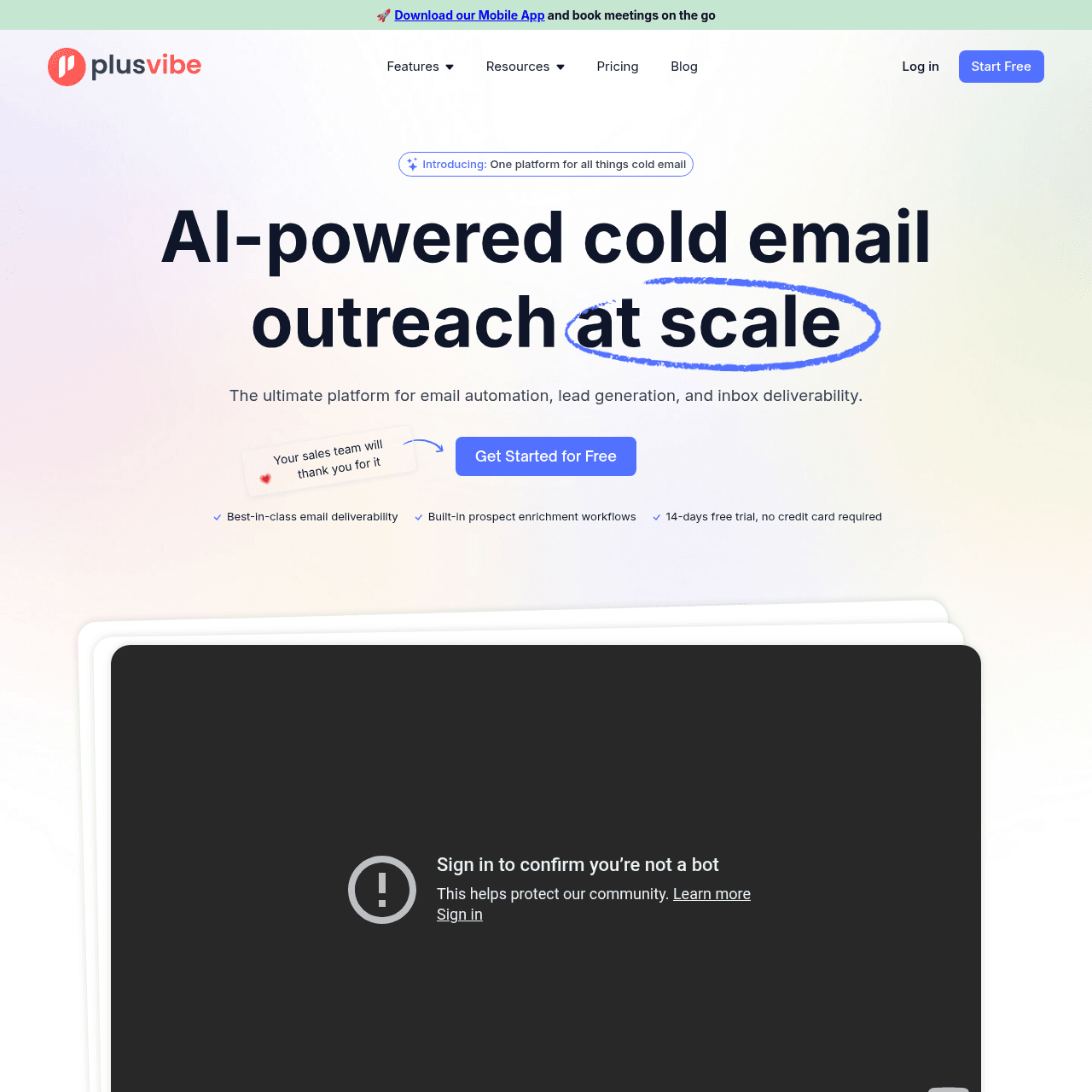
PlusVibe Screenshots
Ready to switch?
Your reputation, your control. No shared infrastructure.
Keep reading
Got questions? We've got answers.
PlusVibe. Most operators ship their first campaign within an hour because the AI writer covers the copy step and infrastructure setup is minimal. SendKit takes 90 to 120 minutes the first time because mailbox routing and warmup confirmation are part of the setup.
Ready to hit primary?
Set up SendKit's isolated infrastructure and start sending in under 15 minutes.
Dedicated IPs on every plan. Cancel anytime.