
 vs
vs
Lemlist vs EmailBison (2026): Per-Seat Multichannel vs Workspace Infrastructure
Lemlist invests per seat in multichannel creative capability. EmailBison invests one workspace fee in premium email infrastructure. The products barely overlap in what they prioritize.

The Verdict
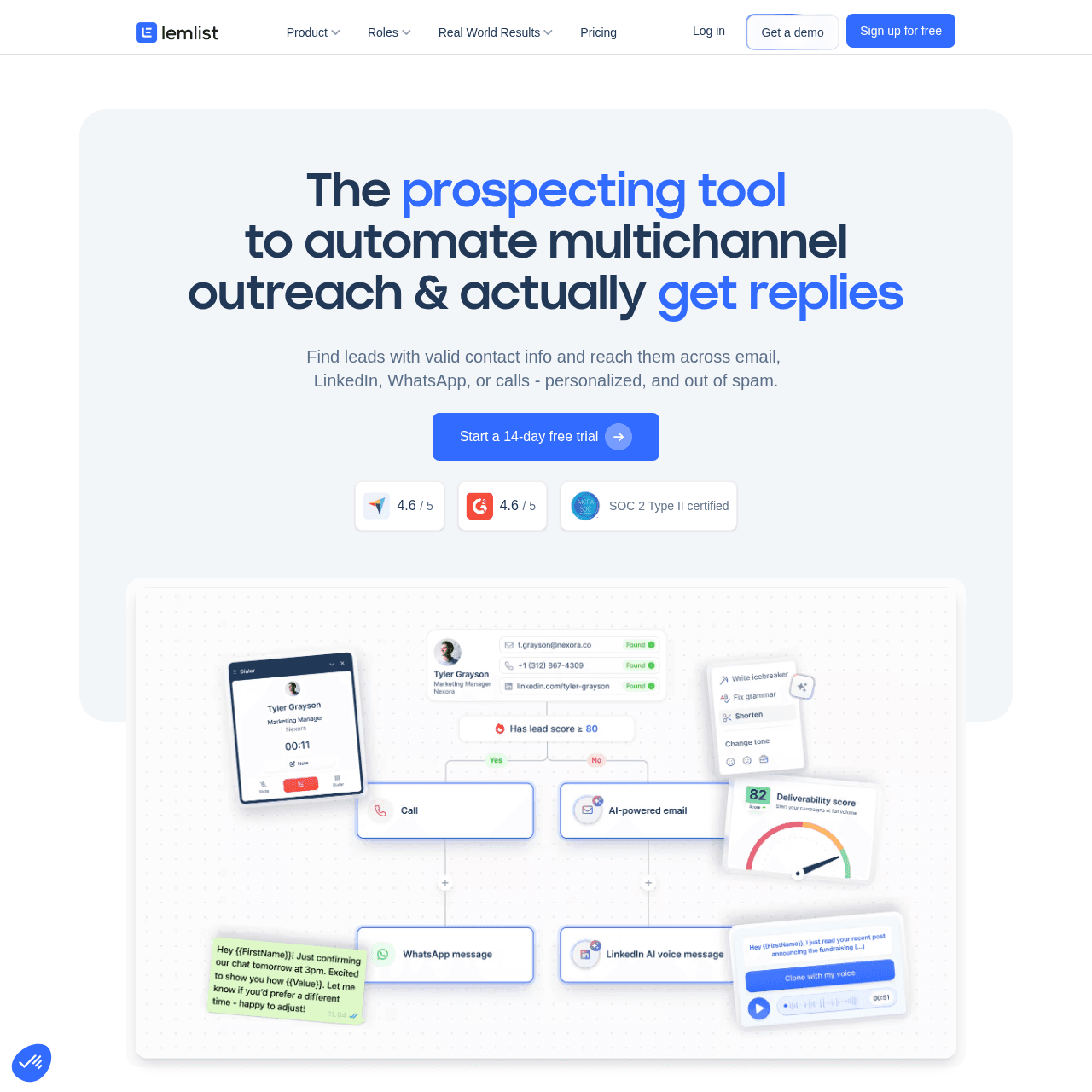
Lemlist and EmailBison are barely competing for the same buyer. Lemlist (Email Pro $79/seat, Multichannel Expert $109/seat) invests seat fees in creative sequencer depth: LinkedIn integration, WhatsApp messaging, AI personalization for images and landing pages, multichannel sequence orchestration. The product treats email infrastructure as commodity and sequence creativity as the differentiator.
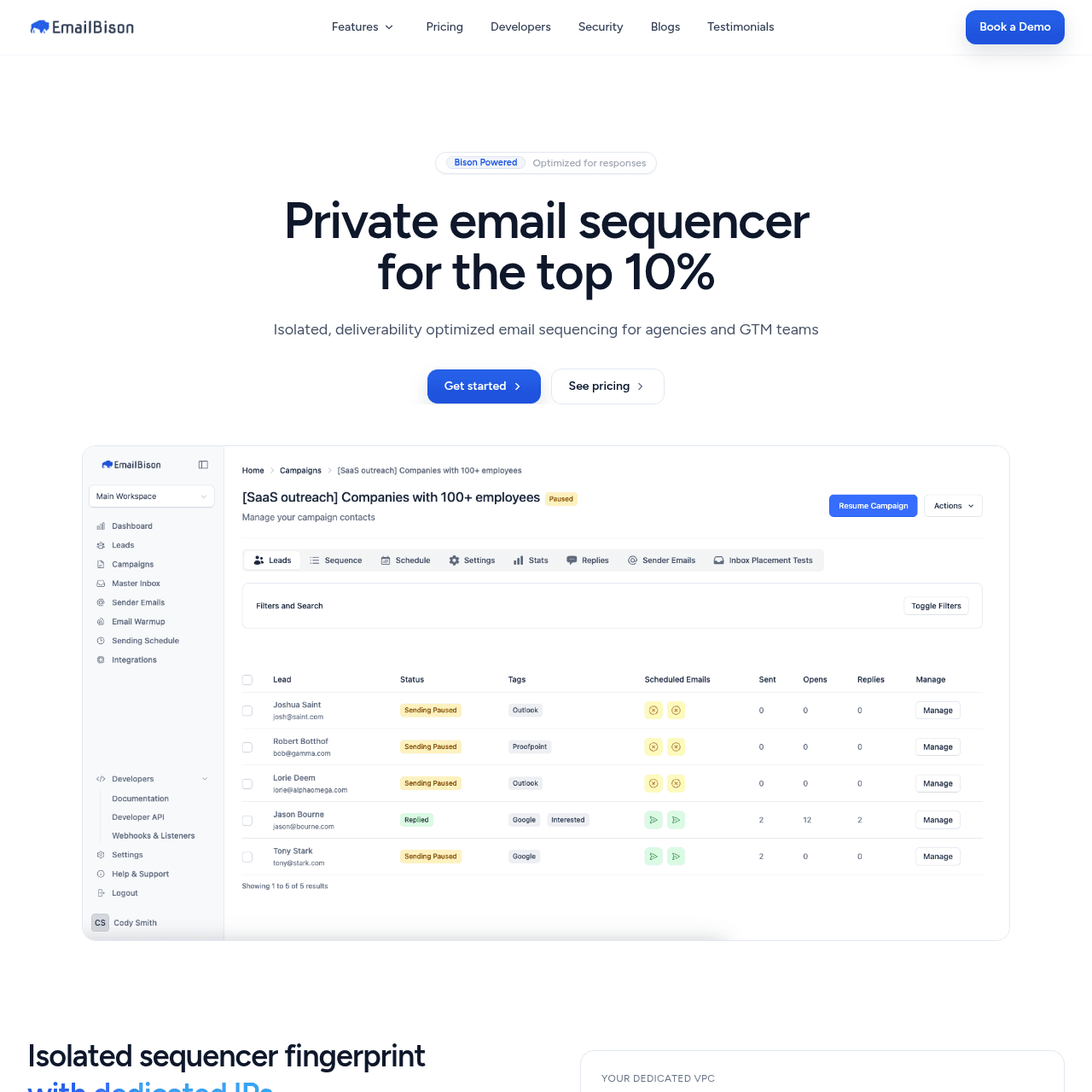
EmailBison ($599/mo single plan) treats the inverse: email infrastructure (dedicated IPs, isolated VPCs, static egress) is the differentiator, and the sequencer is functional but secondary. A team picking Lemlist values "what does the email say" most. A team picking EmailBison values "will this email arrive" most.
The pricing reflects the priority: Lemlist is per-seat because creative output scales with operators; EmailBison is per-workspace because infrastructure capacity scales with volume. Most teams who buy both are running them simultaneously to cover both ends of the workflow.
Lemlist vs EmailBison: Feature-by-Feature
| Feature |  Lemlist Lemlist |  EmailBison EmailBison |
|---|---|---|
| Infrastructure | ||
| Dedicated IPs | No No dedicated IP option on any plan | Yes Dedicated IPs included on the $599/mo plan |
| Isolated Infrastructure | No Shared rotating IPs | Yes Isolated VPCs with static egress |
| Email Warmup | lemwarm Built-in warmup tool included | Yes Email warmup included |
| Pricing | ||
| Pricing Model | Per-user $79-$109+ per user per month | Flat rate Single plan at $599/mo |
| Starting Price | $79/user/mo Email Pro: 3 sending emails per user | $599/mo Single plan: 500K emails, dedicated IPs |
| Channels | ||
| LinkedIn Automation | Yes Profile visits, invites, messages (Multichannel Expert) | No No LinkedIn automation |
| Built-in Dialer | Yes Calling in Multichannel Expert plan | No No built-in dialer |
| Features | ||
| Lead Database | 450M+ contacts Built-in lead finder with email and phone | No No lead finder |
| AI Reply Tagging | AI categorization AI-powered reply detection | Yes AI reply tagging available |
| CRM Integrations | Native + Zapier HubSpot, Salesforce, Pipedrive native | Clay, HubSpot, Salesforce API and webhooks for integrations |
| Scale | ||
| White-label | No No white-label option | Yes White-label branding available |
Seat compounding on Lemlist vs the EmailBison bucket
Lemlist's pricing math behaves differently than the sticker suggests. Email Pro is $79/seat and Multichannel Expert is $109/seat, but the seat is only the base unit. Active Lemlist teams typically layer add-ons: extra sending emails per user, the WhatsApp module at $20/user, the lemcal scheduler, lead finder credits, and the agency layer for sub-account management.
By the time a four-person sales team is fully provisioned on Multichannel Expert, the bill compounds into the high $500s once add-ons are included, which is the threshold where EmailBison's flat $599 starts to look competitive on price alone. EmailBison goes the other direction. One published tier, $599 for 500K monthly sends.
Adding sending volume means buying another 500K bucket for another $599 with no volume discount; the bucket model is intentionally flat. The pricing is more predictable for finance teams (one workspace fee, no headcount tracking) but punishes teams whose volume falls below 500K because the floor is the same as the ceiling at that tier. The key insight: Lemlist scales unpredictably with team growth and feature adoption.
EmailBison scales predictably but only in 500K chunks. Different operating models pick differently.
Key takeaways
- Lemlist: $79-$109 base seat plus 5-7 compounding add-ons
- EmailBison: one published tier at $599 for 500K sends
- Lemlist bills track headcount and feature adoption
- EmailBison bills jump in flat 500K buckets, no volume discount
Creative sequence depth (Lemlist) vs sending-engine quality (EmailBison)
Lemlist invests its R&D budget in the creative end of cold email. Liquid syntax personalization, image personalization at the variable level, dynamic landing pages, video personalization, lemcal scheduling, and the strongest native LinkedIn automation in the category (profile visits, invite-with-note, scheduled messages, voice notes). The product treats the sequencer as the differentiator and assumes email infrastructure is good enough on shared IPs.
EmailBison inverts that allocation. The R&D investment is on the sending engine: isolated VPCs, static egress, private networking, EmailGuard for placement testing, dedicated IPs not shared with anyone. The sequencer surface (A/B testing, conditional steps, master inbox, AI reply tagging) is functional but secondary to the deliverability story.
A buyer who picks Lemlist over EmailBison is saying creative depth beats infrastructure depth for their use case. A buyer who picks EmailBison over Lemlist is saying the opposite. Teams running ABM into 200 named accounts where each touch must be highly personalized lean Lemlist.
Teams running 100K+ monthly volume where each percentage point of inbox placement is revenue lean EmailBison.
Key takeaways
- Lemlist: image, video, page, and LinkedIn personalization
- EmailBison: VPCs, static egress, dedicated IPs, EmailGuard
- Two opposite R&D bets in the same category
- Choose by which side of the workflow drives your revenue
LinkedIn automation: a Lemlist advantage with no EmailBison equivalent
Lemlist's LinkedIn module is one of the strongest in the cold email category, not just present. Connection requests with personalized notes, sequential message threads, profile visits scheduled to mimic human behavior, voice note delivery, and the ability to mix LinkedIn steps into email sequences with conditional branching. This is the differentiator that justifies the $109/seat Multichannel Expert tier for teams who treat LinkedIn as a co-channel rather than a separate workflow.
EmailBison has no LinkedIn automation, no WhatsApp module, no native calling. The product is email-only by design. Teams running multichannel sequences with EmailBison must bolt on a separate LinkedIn tool (HeyReach, Expandi, La Growth Machine) and reconcile reporting across two platforms.
The integration is workable but never as clean as having both channels in the same sequencer. This gap is the single largest reason the two tools are not actually substitutes. A team committed to LinkedIn-plus-email outbound cannot replace Lemlist with EmailBison without giving up sequencing depth.
A team committed to high-volume email-only cannot replace EmailBison with Lemlist without giving up infrastructure quality.
Key takeaways
- Lemlist native LinkedIn: invites, messages, profile visits, voice notes
- EmailBison: no LinkedIn, no WhatsApp, no dialer
- Multichannel buyers cannot substitute EmailBison for Lemlist
- High-volume email-only buyers cannot substitute Lemlist for EmailBison
Why some teams actually run Lemlist and EmailBison simultaneously
The most useful observation about this comparison: a non-trivial number of teams who have looked at both end up running them in parallel rather than picking one. The pattern is segment-by-segment. Lemlist handles the high-touch ABM book where each contact gets manual sequence tuning and LinkedIn integration matters.
EmailBison handles the high-volume top-of-funnel where 50K-200K sends per month need to actually arrive in the inbox. The combined bill is steep (Lemlist seats plus EmailBison workspace), but the operational logic is clean: the two products do not overlap enough to consolidate, and the workflow gain from using each in its strength zone justifies the duplicate spend. Teams running this configuration usually have a clear split between an inside-sales motion (Lemlist) and a growth-marketing motion (EmailBison) with different KPIs.
Key takeaways
- Running both is a documented pattern, not a workaround
- Lemlist for high-touch ABM with LinkedIn integration
- EmailBison for high-volume top-of-funnel email
- The two workflows rarely overlap enough to consolidate
Pros & Cons
Lemlist
Strengths
- Multichannel: email, LinkedIn, WhatsApp, calling
- 450M+ lead database built in
- AI-powered reply categorization
- Lower entry price for solo users ($79/mo)
- Strong personalization features
Limitations
- Per-user pricing gets expensive for teams
- No dedicated IPs on any plan
- Shared rotating IP infrastructure
- LinkedIn limits per sender
- WhatsApp is a paid add-on ($20/user/mo)
EmailBison
Strengths
- Dedicated IPs and isolated VPCs included
- Static egress and private networking
- EmailGuard inbox placement testing
- Unlimited teammates, no per-seat pricing
- Dedicated Slack support
Limitations
- Single plan at $599/mo with no lower-tier option
- Email only, no multichannel outreach
- No lead finder or prospecting database
- No ESP matching or SEG detection
- No dialer or CRM
Got questions? We've got answers.
The cross-over point depends on plan and add-ons. On Multichannel Expert ($109/seat), a five-person team is roughly $545 before any add-ons; once add-ons compound (WhatsApp at $20/seat, extra sending emails, lemcal), the team typically lands in the $700-$900 range, comfortably above the EmailBison $599. Solo and small teams stay cheaper on Lemlist; mid-sized teams cross over once add-on adoption matures.
Ready to hit primary?
Set up SendKit's isolated infrastructure and start sending in under 15 minutes.
Dedicated IPs on every plan. Cancel anytime.